On Friday, 24 July, a message popped up on our Whale Whisperer whale watching vessel group chat:
“Possible diving petrel.”
The excitement was immediate.
For avid birders like Marine Dynamics CEO Wilfred Chivell, marine biologist Sandra Hoerbst, and skippers Hennie Odendal and Hennie Otto, the message sparked instant excitement. The four of them were absolutely elated, immediately making plans to photograph the tiny visitor. The rest of us simply looked at one another, wondering how a little black-and-white bird had suddenly become the most exciting thing to happen all day.
As it turned out, there was good reason for their enthusiasm.
I’ll admit, until recently I was still learning to tell the difference between a Roseate Tern and a Swift Tern, so I had to ask the obvious question:
What makes this little bird so extraordinary?
As it turns out…quite a lot.
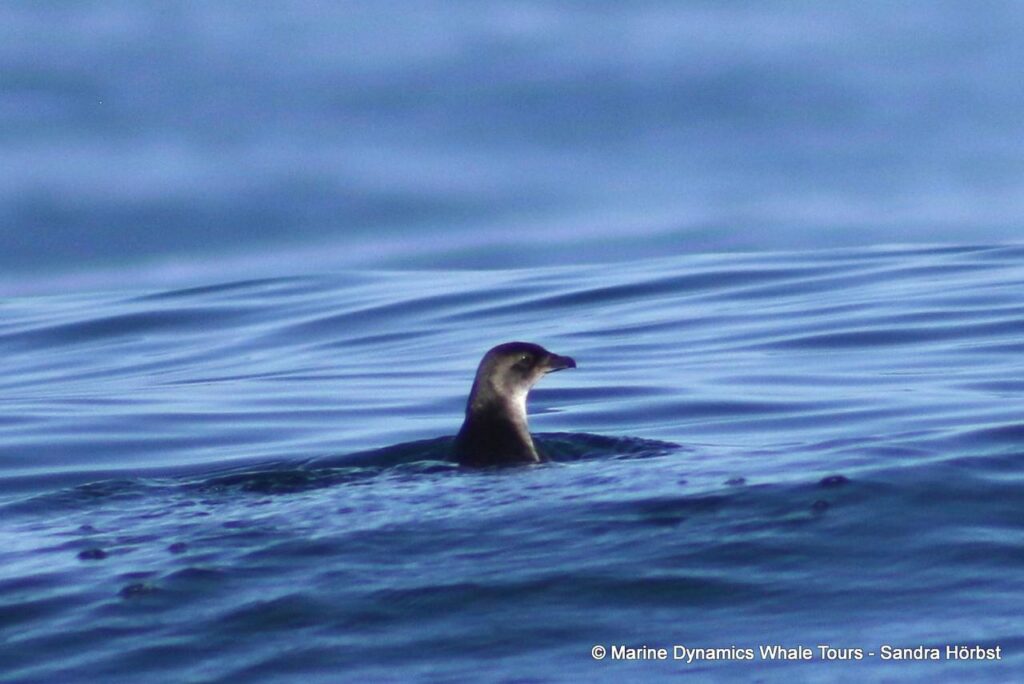
The bird was identified as a Common Diving Petrel (Pelecanoides urinatrix), one of the Southern Ocean’s smallest and most remarkable seabirds.
Measuring just 19 to 23 centimetres long and weighing 120 to 200 grams, about the weight of a small apple, it is perfectly adapted for life at sea. Despite its tiny size, it is an exceptional diver, using its short wings almost like flippers to “fly” underwater in pursuit of prey. It feeds primarily on krill, copepods, amphipods and other small crustaceans, as well as tiny fish and squid, diving repeatedly beneath the surface to forage.
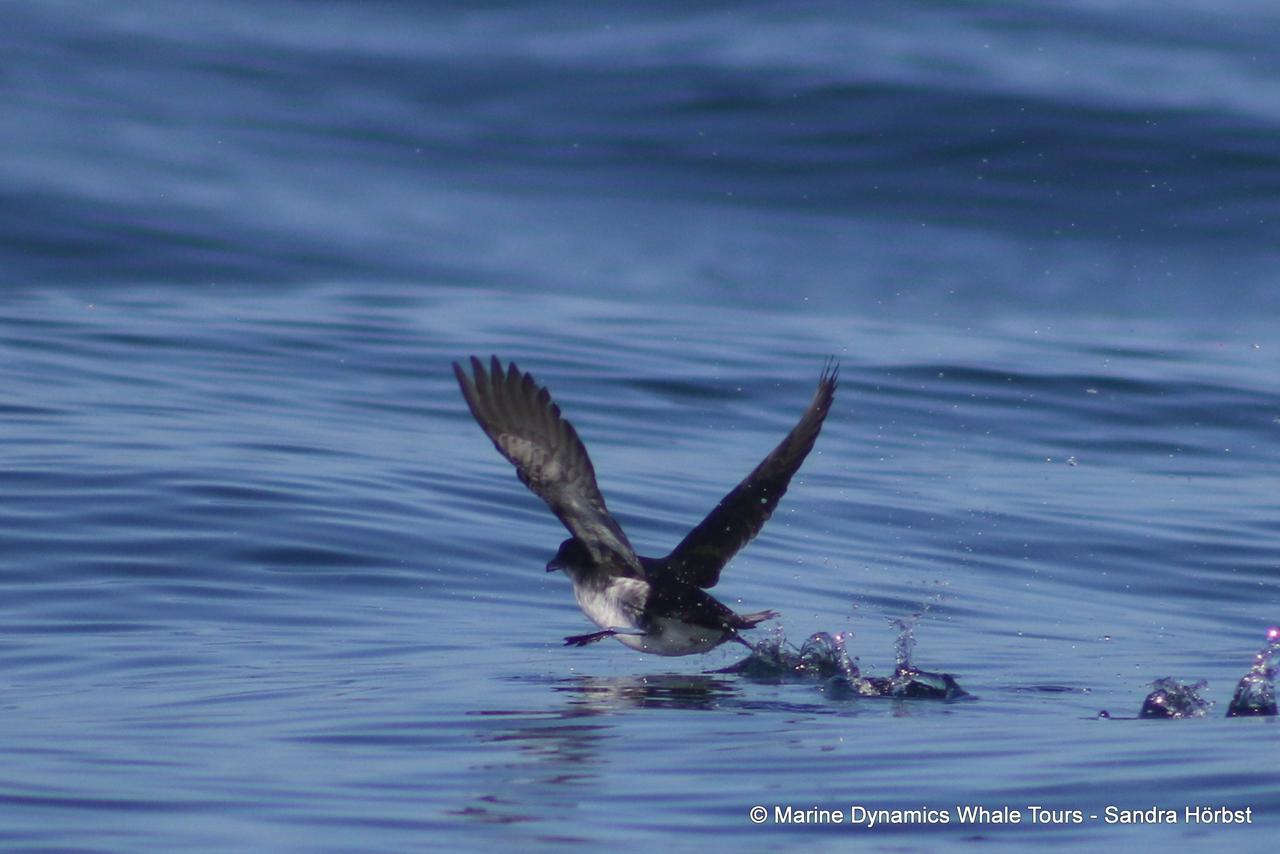
Above the water, it flies low and fast over the waves with rapid, whirring wingbeats and rarely glides. When disturbed, it is more likely to dive beneath the surface than take to the air, making it surprisingly difficult to observe.
These birds breed on remote islands scattered throughout the Southern Ocean, including South Georgia, the Prince Edward Islands, Crozet, Kerguelen, New Zealand, Tasmania and islands off southern Chile. Outside the breeding season they disperse widely across the cold, nutrient-rich waters of the Southern Ocean, often travelling hundreds or even thousands of kilometres between feeding and breeding grounds while spending almost their entire lives at sea.
What makes this sighting so exciting is just how rarely they are recorded from mainland South Africa.
According to the 2022 scientific paper, “First Record of a Common Diving Petrel Pelecanoides urinatrix from Continental Africa, and a Summary of Diving Petrel Distribution in the Southern Ocean,” by Peter G. Ryan, Vincent L. Ward and Susan M. Miller, the first confirmed record from continental Africa occurred only in March 2021, when a deceased Common Diving Petrel was found on a beach near Cape Town. The authors note that these birds are typically found 1,500 to 2,000 kilometres southwest of Cape Town during March, while other populations occur even farther south in Antarctic waters. Their appearance along the South African coastline remains exceptionally uncommon.
That makes every sighting in the Greater Dyer Island ecosystem something special.
Known worldwide for its extraordinary diversity of marine wildlife—including Southern Right Whales, Bronze Whaler Sharks, Cape Fur Seals, African Penguins and several dolphin species—the Greater Dyer Island ecosystem continues to surprise us with unexpected visitors from the wider Southern Ocean.
For birders, a Common Diving Petrel is a species that many hope to see but few are fortunate enough to encounter. For scientists, each observation contributes to our understanding of seabird distribution and oceanic ecosystems. And for our guests, it is another reminder that every marine safari is unique.
As someone who still keeps a Roberts Bird Guide close at hand, I continue to be amazed by the feathered visitors that grace these waters. Every trip offers the possibility of something unexpected, and this tiny seabird is proof that even the smallest wildlife encounters can become unforgettable moments.
So, next time you join us on a whale watching tour, don’t forget your binoculars—and definitely pack your bird guide. You never know what remarkable visitor from the Southern Ocean might make an appearance.
Christine Wessels – [email protected]