Stranded white shark on the shore of Dyer Island
 On Wednesday 20 June 2012, the Dyer Island Conservation Trust (dict.org.za/old) in Gansbaai was alerted to a stranded white shark on the shore of Dyer Island by commercial cage dive operator White Shark Projects. The first attempt at recovery late Thursday afternoon was halted by strong winds and large swells. The second attempt early Thursday 21 June was a success.
Alison Towner, DICT Marine biologist, explains, The shark was a large 3.5-4.0m male. To have a white shark wash on shore Dyer Island is a very rare event. We are unsure of the cause of death, as there are no apparent external injuries or markings. Excluding abrasions from the rugged shore, the shark’s body was in immaculate condition, his fins and jaws intact. There are no research tags on this shark and we have not yet identified him in our database.
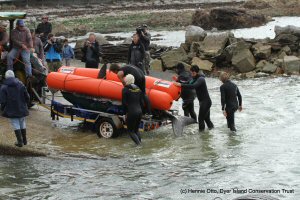
The recovery effort included the DICT’s new inflatable cradle designed for lifting, towing, and moving large stranded animals. We weren’t expecting to use it like this, that is for sure, says DICT founder, Wilfred Chivell. This cradle is only one month old, and we have already used it on two large animals; this white shark and a stranded Bryde’s whale calf. I don’t know how we could have recovered the shark today without this equipment. The white shark was moved from the shore onto the cradle by a team of volunteers and then towed 8.5km back to Kleinbaai harbour from Dyer Island.
Swimming out a 3.5m long 800kg animal in 3.0m swells and 25kt winds and then towing it home was not easy, says DICT zoologist and rescue boat skipper, Michelle Wcisel. The success all comes down to a great team effort. Due to the challenging conditions and tides, the Trust launched two research vessels, Lwazi and Calypso, as well as whale disentanglement vessel Free Willy.
Of course I would rather see white sharks alive than dead, but this was one of the most incredible experiences of my life, I am glad I could help, says rescue volunteer and Marine Dynamics employee, Pieter du Toit.
The white shark was collected in Kleinbaai harbour by the Department of Environmental Affairs who will freeze the animal and perform a full autopsy in the coming weeks.
The Dyer Island Conservation Trust would like to thank all the volunteers and the crew of Marine Dynamics and Dyer Island Cruises who assisted in the white shark recovery, and a special thanks to Dicky Chivell, Pieter du Toit, Albert Scholtz and Khwezi Balena.